New NCERT Understanding Society: India and Beyond · Class 9 Social Science · Part 2 · Chapter 12: Resistance and Resilience (1000-1700 CE)
This chapter covers India from 1000 to 1700 CE, a time of invasions and wars. It shows how regional powers resisted by arms and culture, and how Indian civilisation stayed resilient and kept its core ideas and values.
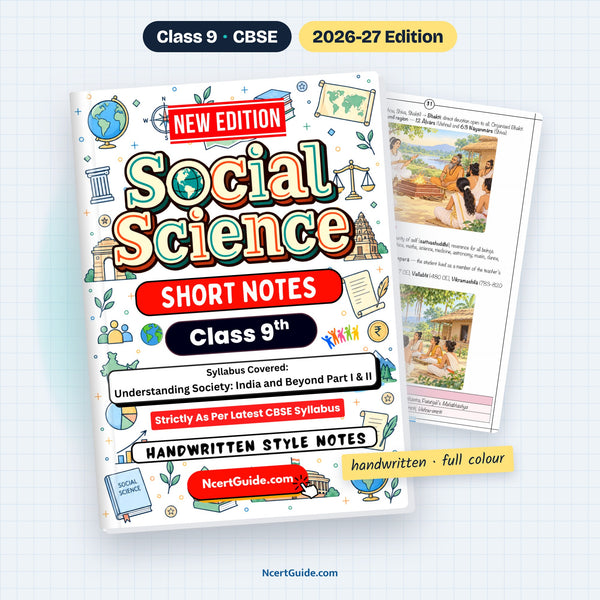
From the Class 9 Social Science Short Notes, made as per the new NCERT book Understanding Society: India and Beyond · Pages 71–79 of the book.
Key points
- Resistance is actively opposing a threat; resilience is the capacity to survive and adapt while keeping traditions alive.
- Mahmud of Ghazni first invaded in 1001; in 1178 Naiki Devi defeated Muhammad Ghuri at Kasahrada.
- The Delhi Sultanate (1206) brought greater centralisation through the iqta system.
- Babur won the First Battle of Panipat in 1526 and defeated Rana Sanga at Khanua in 1527.
- Mewar resisted the Mughals: Battle of Haldighati (1576) and Battle of Dewair (1582); the Bhils helped Maharana Pratap.
- The Ahoms stayed independent for almost six centuries (1228–1826); Lachit Borphukan won the Battle of Saraighat (1671).
- Harihara and Bukka founded Vijayanagara in 1336; it was defeated at Talikota in 1565.
- Chhatrapati Shivaji set up an independent Maratha state in 1674 as a champion of Swarajya.
- Guru Gobind Singh founded the Khalsa in 1699.
- The Bhakti movement spread devotion in local languages; Sufism was the mystical side of Islam.
- A strong economy — farming, trade, merchants and hundi — gave people the resources to resist.
Key terms
- Resilience: The capacity to survive and adapt while keeping traditions alive.
- Iqta system: Territories given to military commanders instead of salaries under the Delhi Sultanate.
- Mansab: A 'rank' or 'office' in Akbar's mansabdari system.
- Swarajya: Self-rule, free from external control.
- Miri-Piri: The Guru's authority over worldly (miri) and spiritual (piri) affairs.
- Sulh-i-Kul: Akbar's policy of 'peace with all' or universal toleration.
- Hundi: A bill of exchange used for big deals and long-distance remittance without carrying cash.
Diagrams to learn
- Resistance and resilience diagram
- Table: Mewar's resistance against the Mughals
- Table: Ahom–Mughal events
- Table: Maratha forts
- Timeline of powers (1000–1700 CE)
- Table: prominent Bhakti saints by region
- Table: dates to remember
- Resilience is the backbone of resistance.
- Nirguna bhakti is devotion to a formless divine; saguna bhakti is devotion to a divine with attributes.
- Key dates: Vijayanagara 1336, Panipat 1526, Talikota 1565, Haldighati 1576, Saraighat 1671, Shivaji crowned 1674, Khalsa 1699.
A real page from the book

Get the full chapter in the book
This page is a summary. The Class 9 Social Science Short Notes has the complete chapter in colour, with every diagram and worked example.
Frequently asked questions
What is the difference between resistance and resilience?
Resistance means actively opposing a force or threat to protect power, land and identity. Resilience is the capacity to survive and adapt while keeping traditions alive.
Who won the Battle of Saraighat?
In 1671, the Ahom commander Lachit Borphukan defeated a Mughal fleet at Saraighat. The Ahoms stayed independent for almost six centuries.
When was the Vijayanagara Empire founded?
Harihara and Bukka founded Vijayanagara, the 'City of Victory', in 1336 near Hampi in Karnataka. It was defeated by an alliance of the Deccan sultanates at the Battle of Talikota in 1565.
← Part 2 · Chapter 11: Life on EarthPart 2 · Chapter 13: Governance and Public Policy →