New NCERT Understanding Society: India and Beyond · Class 9 Social Science · Part 2 · Chapter 11: Life on Earth
This chapter explains how climate, landforms and water shape life on Earth through biomes. It also covers biodiversity and its conservation, forest ecotourism, forest dwellers and their livelihoods, and shared resources called ecological commons.
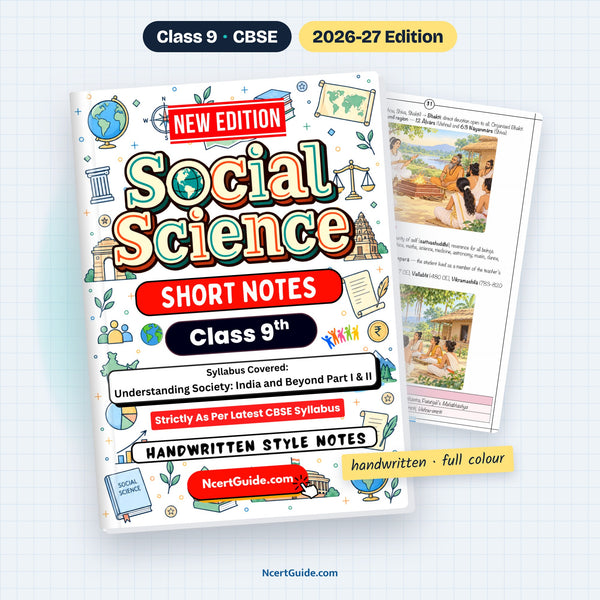
From the Class 9 Social Science Short Notes, made as per the new NCERT book Understanding Society: India and Beyond · Pages 63–70 of the book.
Key points
- A biome is a large natural region where certain plants and animals live under similar climatic conditions.
- An ecosystem is like a neighbourhood within a biome.
- Biomes are terrestrial (forest, grassland, desert, tundra) or aquatic (freshwater, marine).
- Tropical rainforests lie between 23.5° N and 23.5° S and are the world's richest store of biodiversity — a 'gene bank'.
- Aquatic biomes cover about three-fourths of the Earth's surface.
- A biome pyramid shows producers at the base; energy, number and biomass decrease going up.
- Biodiversity hotspots in India include the Himalaya, Western Ghats, North-East India and Andaman & Nicobar.
- Thenmala in Kerala is India's first planned ecotourism destination.
- Forest dwellers, especially women, manage forest resources; the Bishnoi Movement influenced the Chipko Movement.
- The Forest Rights Act, 2006 recognises forest dwellers' rights; Mendha Lekha was the first village to gain rights over its forest.
- Ecological commons are resources shared by a community, such as forests, rivers and grazing land.
Key terms
- Biome: A large natural region where certain plants and animals live under similar climatic conditions.
- Biodiversity: The variety of life on Earth — plants, animals, microorganisms and their ecosystems.
- Permafrost: Soil frozen almost all year round, as in the tundra.
- Trophic level: Each feeding level in a pyramid — producers, herbivores, carnivores and top predators.
- Ecotourism: Travelling to nature-friendly places without harming the environment, while respecting local people.
- NTFPs: Non-timber forest products — honey, fruits, nuts, resins, lac and medicinal plants.
- GI tag: An intellectual property right that links a product's quality or reputation to the place it comes from.
- Ecological commons: Natural resources shared and used together by a community, not owned by one person.
Diagrams to learn
- Classification of biomes chart
- Layers of a rainforest
- Biome pyramid
- Table: grassland, desert and tundra biomes
- Table: GI-tagged forest products
- Table: challenges faced by forest dwellers
- Biome vs ecosystem: a biome is a broad region; an ecosystem is a neighbourhood within it.
- Energy is lost as heat at each trophic level, so energy decreases going up the pyramid.
- Tundra = permafrost; taiga = conifers (pines, spruces and larches).
A real page from the book

Get the full chapter in the book
This page is a summary. The Class 9 Social Science Short Notes has the complete chapter in colour, with every diagram and worked example.
Frequently asked questions
What is a biome?
A biome is a large natural region of the world where certain types of plants and animals live under similar climatic conditions. The word comes from bios (life) and -ome (a group).
What is a biome pyramid?
A biome pyramid shows the relationship between organisms in terms of energy, number or biomass. Producers form the base, then herbivores, carnivores and top predators; energy decreases at each level.
What is the Forest Rights Act, 2006?
It recognises the rights of Scheduled Tribes and other traditional forest dwellers over forest land and resources. It allows collecting minor forest produce and gives ownership of small cultivated patches.
← Part 2 · Chapter 10: Oceans and LifePart 2 · Chapter 12: Resistance and Resilience (1000-1700 CE) →