New NCERT Understanding Society: India and Beyond · Class 9 Social Science · Part 1 · Chapter 6: Democracy
This chapter explains democracy — a government in which power lies with the citizens. It covers India's democratic traditions, the making of the Constitution, the principles and types of democracy, and the challenges democracy faces.
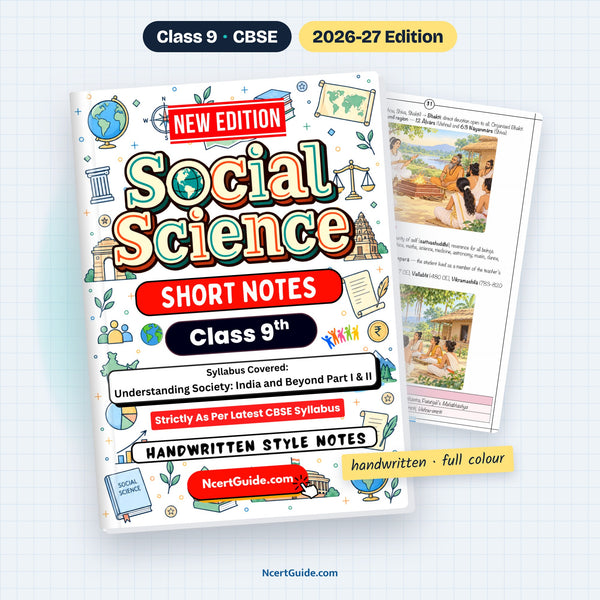
From the Class 9 Social Science Short Notes, made as per the new NCERT book Understanding Society: India and Beyond · Pages 34–39 of the book.
Key points
- In a democracy, power lies with citizens, who elect representatives through free and fair elections.
- India is the world's largest democracy, with over 96.8 crore voters (2024).
- The Constitution was adopted on 26 November 1949 and came into force on 26 January 1950; Dr B.R. Ambedkar chaired the Drafting Committee.
- Early democratic traditions include the sabhā, samiti, vidatha, gaṇas/saṅghas and voting in the Bauddha Saṅgha.
- Principles of democracy include popular sovereignty, rule of law, Fundamental Rights, separation of powers and accountability.
- Every citizen aged 18 or above can vote by secret ballot — Universal Adult Franchise.
- There are six Fundamental Rights, enforceable through Articles 32 and 226.
- Democracy can be direct (Switzerland) or representative; representative democracy can be parliamentary (India) or presidential (USA).
- India has three tiers of government — Union, State and Local.
- The Emergency (1975–77) suspended most Fundamental Rights; the 1977 elections showed the resilience of Indian democracy.
- Challenges include illiteracy, fake news, poverty, inequality and social discrimination.
Key terms
- Democracy: A form of government in which power and authority lie with the citizens.
- Universal Adult Franchise: Every citizen aged 18 or above has the right to vote.
- Rule of law: Equality before law; no one is above the law.
- Federalism: Power shared between the centre and the states.
- Sovereignty: Supreme, final, independent authority of a state.
- Quorum: Minimum number of members that must be present for a meeting's decisions to be valid.
- Civil society: Voluntary groups, NGOs and community associations.
Diagrams to learn
- Table: principles of democracy
- Table: six Fundamental Rights and Articles
- Types of democracy tree diagram
- Table: democracies around the world
- Table: student council models
- Media is called the fourth pillar of democracy.
- Know the Fundamental Rights Articles: 14–18, 19–22, 23–24, 25–28, 29–30 and 32; Right to Education is Article 21A (2009).
- Women's reservation: not less than one-third of seats in Panchayats (Art. 243D) and Municipalities (Art. 243T).
A real page from the book

Get the full chapter in the book
This page is a summary. The Class 9 Social Science Short Notes has the complete chapter in colour, with every diagram and worked example.
Frequently asked questions
When did the Constitution of India come into force?
The Constitution was adopted on 26 November 1949 and came into force on 26 January 1950. The Constituent Assembly took 2 years, 11 months and 18 days to draft it.
What is the difference between direct and representative democracy?
In a direct democracy, citizens take most decisions themselves, as in Switzerland. In a representative democracy, people elect representatives who are accountable to them, as in India.
What are the six Fundamental Rights?
Right to Equality, Right to Freedom, Right against Exploitation, Right to Freedom of Religion, Cultural and Educational Rights, and Right to Constitutional Remedies.
← Part 1 · Chapter 5: State and Society up to 1000 CEPart 1 · Chapter 7: Elections →