New NCERT Understanding Society: India and Beyond · Class 9 Social Science · Part 1 · Chapter 5: State and Society up to 1000 CE
This chapter explains how society and the state grew in India up to 1000 CE. It covers the Vedas, the growth from jana to empires, ideas of kingship and administration, social life, religion, learning and the economy.
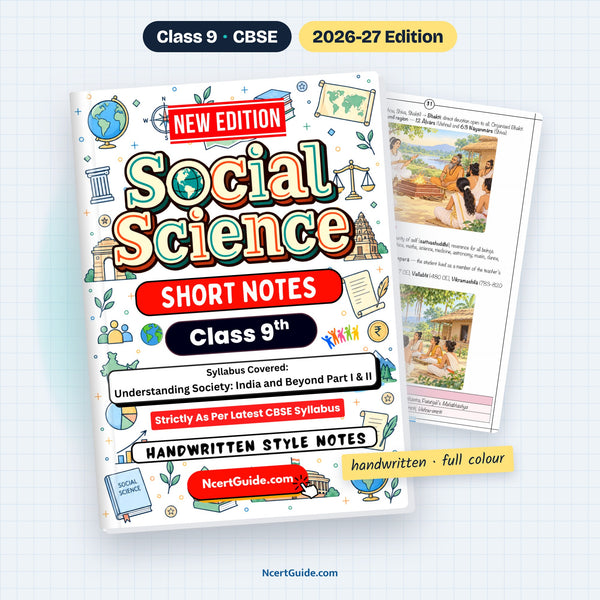
From the Class 9 Social Science Short Notes, made as per the new NCERT book Understanding Society: India and Beyond · Pages 26–33 of the book.
Key points
- Society is based on customs and practices; the state is based on rules and laws.
- Polity grew from jana (kin-based clans) to janapada, mahājanapada (16 bigger states) and empires.
- There are four Vedas: Rig, Yajur, Sāma and Atharva; the Rig Veda is the earliest, with 1,028 hymns.
- Vedic assemblies were the sabhā, samiti and vidatha; kingship was mostly hereditary, but kings could be elected or expelled.
- Magadha became the most powerful mahājanapada and led to the Mauryan Empire.
- Kauṭilya's Saptāṅga says the state has seven limbs: king, ministers, territory, fort, treasury, army and allies.
- Empires were divided into provinces, divisions, districts and villages; the Cholas had self-reliant village assemblies.
- The Uttaramerur inscription describes the kuḍavolai (ballot pot) system of the Cholas.
- Early Vedic texts show no fixed status by birth; varṇas were functional and later fixed at four, while jātis had no fixed number.
- Life was divided into four āśhramas and four puruṣhārthas: dharma, artha, kāma and moksha.
- Centres of learning included Takshaśhilā, Nālandā, Vallabhī and Vikramaśhilā; guilds (shreṇīs) acted like banks.
Key terms
- Janapada: The place where a people (jana) first set its feet — a shift from kinship to territorial identity.
- Mahājanapada: Bigger units of 600–300 BCE; sources usually speak of sixteen.
- Saptāṅga: Kauṭilya's seven limbs of the state.
- Sabhā, samiti, vidatha: Vedic assemblies — a body of select elites, a larger assembly on policy, and a popular gathering.
- Dharma: Duty, righteousness and moral conduct; from the root dhṛ (to uphold).
- Ṛita: The Rig Vedic idea of an all-pervading cosmic order.
- Bhakti: Direct devotion to a personal deity, open to all.
- Shreṇīs: Guilds — associations of traders and artisans.
Diagrams to learn
- Flowchart: jana → janapada → mahājanapada → empires
- Saptāṅga — seven limbs of the state
- Table: administrative units in North and South India
- Four āśhramas diagram
- Timeline to remember
- Map practice — places to locate
- Don't confuse: Brahman = a concept; Brāhmaṇas = texts; brāhmaṇas/Brahmins = a varṇa.
- Like modern parliaments, Vedic assemblies show that people took part in governance from early times.
- Cheras, Cholas and Pāṇḍyas of the Sangam age should not be confused with the later imperial Cholas.
A real page from the book

Get the full chapter in the book
This page is a summary. The Class 9 Social Science Short Notes has the complete chapter in colour, with every diagram and worked example.
Frequently asked questions
What are the four Vedas?
The four Vedas are the Rig Veda (earliest, 1,028 hymns), Yajur Veda (yajñas), Sāma Veda (hymns for musical recitation) and Atharva Veda (hymns to ward off evil and ailments).
What is Saptāṅga?
Saptāṅga is Kauṭilya's idea of the seven limbs of the state: king, ministers, territory, fort, treasury, army and allies. The state works only when all seven parts work together.
What was the kuḍavolai system?
It was the 'ballot pot' system described in the Uttaramerur inscription of Parāntaka I. Names were written on palm leaves and put in a pot, and a child drew them to choose members of village committees.
← Part 1 · Chapter 4: Early Humans and the Beginning of CivilisationPart 1 · Chapter 6: Democracy →