New NCERT Understanding Society: India and Beyond · Class 9 Social Science · Part 1 · Chapter 4: Early Humans and the Beginning of Civilisation
This chapter traces the long journey of humans from early ancestors in Africa to the first civilisations. It covers the Stone Age periods, the shift to farming, and the Bronze Age river-valley civilisations of the Harappans, Mesopotamia, Egypt and China.
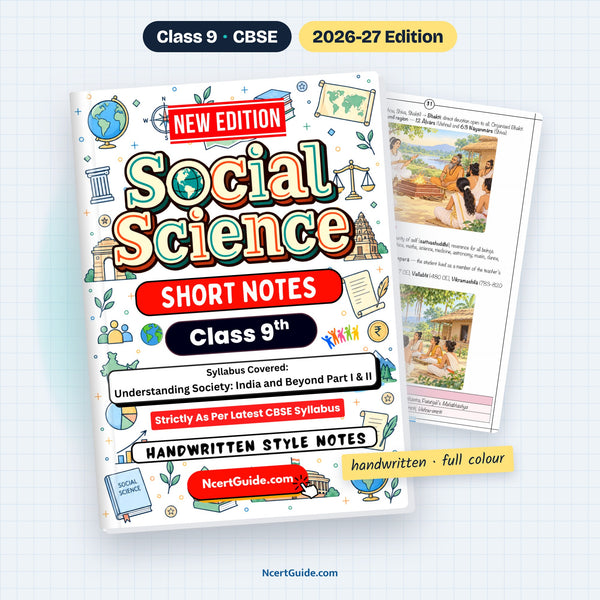
From the Class 9 Social Science Short Notes, made as per the new NCERT book Understanding Society: India and Beyond · Pages 18–25 of the book.
Key points
- Prehistory covers more than 99% of human history; history (after writing) covers less than 1% — the last 5000 years.
- Our earliest ancestors evolved in Africa; Homo erectus was the first hominin to leave Africa, around 2 million years ago.
- Homo sapiens evolved in Africa around 3,00,000 years ago and are the only human species living today.
- Periods of early human history: Palaeolithic, Mesolithic, Neolithic, Chalcolithic, Bronze Age and Iron Age.
- Attirampakkam (Tamil Nadu) and Isampur (Karnataka) are early stone-tool sites in the subcontinent.
- Bhimbetka (Madhya Pradesh) is a World Heritage Site with hundreds of painted rock shelters.
- The Neolithic Revolution was the gradual shift to food production — domestication of plants and animals and the first villages.
- Mehrgarh on the Bolan River is the earliest agricultural village (~7000 BCE).
- Harappan achievements include standard weights, water management at Dholavira and the Lothal dockyard.
- The four Bronze Age river-valley civilisations — Harappan, Mesopotamian, Egyptian and Chinese — grew independently in fertile river plains.
- Mesopotamia gave cuneiform writing and the Code of Hammurabi; Egypt gave the 365-day calendar and papyrus; China gave paper currency and civil service exams.
Key terms
- Artefacts: Tools, implements and objects that are the main source for studying prehistory.
- Fossils: Remains turned to stone over thousands or millions of years.
- Hominins: Modern humans plus our early human-like ancestors.
- Neolithic Revolution: The shift to farming, which completely changed how people lived.
- Microliths: Tiny stone tools of the Mesolithic period.
- Ziggurat: A stepped temple-tower in each Sumerian city, also used as the treasury.
- Cuneiform: Sumerian writing on clay tablets (from Latin cuneus = wedge).
- Oracle bones: Animal bones and tortoise shells heated to crack and foretell the future in ancient China.
Diagrams to learn
- Table: before and after writing
- Table: human ancestors
- Flowchart: periods in early human history
- Timeline of the Sindhu-Sarasvatī (Harappan) civilisation
- Bronze Age river-valley civilisations chart
- Timelines of Mesopotamian, Egyptian and Chinese civilisations
- palaeo = old, meso = middle, neo = new, lithic = stone, chalco = copper; bronze = copper + tin.
- The Harappan script (Sindhu lipi) has not been deciphered; cuneiform and hieroglyphs have been deciphered.
- Remember the trade links: Meluhha = Harappans, Dilmun = Bahrain, Magan = Oman.
A real page from the book

Get the full chapter in the book
This page is a summary. The Class 9 Social Science Short Notes has the complete chapter in colour, with every diagram and worked example.
Frequently asked questions
What is the Out of Africa theory?
Our earliest ancestors evolved and lived in Africa. Homo erectus was the first hominin to leave Africa around 2 million years ago, and Homo sapiens left in a major wave around 1,25,000 years ago and spread across the Earth.
What was the Neolithic Revolution?
It was a gradual shift to food production through domestication of select plants and animals, pottery and the first villages. It happened at different times in different regions and became the base for later cities.
Which was the earliest agricultural village in the subcontinent?
Mehrgarh on the Bolan River (present-day Pakistan), around 7000 BCE. People there built sun-dried brick houses and granaries and grew wheat and barley.
← Part 1 · Chapter 3: Atmosphere and ClimatePart 1 · Chapter 5: State and Society up to 1000 CE →