New NCERT Understanding Society: India and Beyond · Class 9 Social Science · Part 1 · Chapter 3: Atmosphere and Climate
This chapter explains the atmosphere — the blanket of air around the Earth — its gases and layers. It then covers weather and climate, India's seasons and the monsoon, and how human activities are causing climate change.
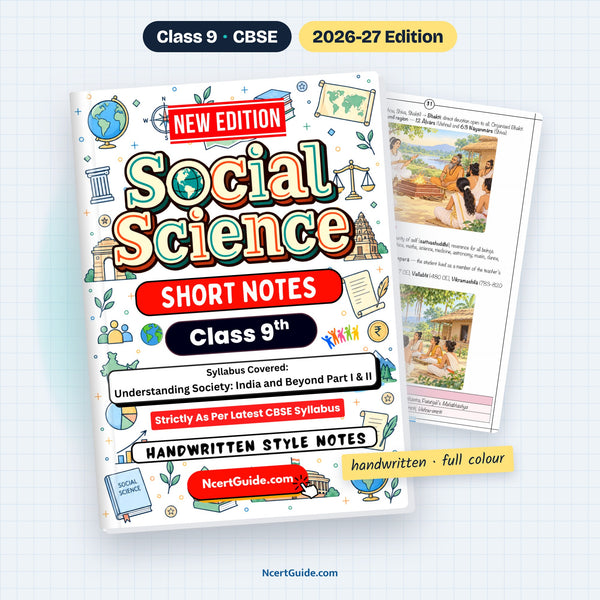
From the Class 9 Social Science Short Notes, made as per the new NCERT book Understanding Society: India and Beyond · Pages 12–17 of the book.
Key points
- The atmosphere is held by gravity; it supports life, shields us from UV radiation and keeps the Earth warm.
- Nitrogen (78%) and oxygen (21%) are the main gases; argon, carbon dioxide, water vapour and dust are also present.
- Layers from the ground up: troposphere, stratosphere, mesosphere, thermosphere and exosphere.
- Nearly all weather happens in the troposphere; the ozone layer is in the stratosphere; meteorites burn up in the mesosphere.
- Weather is the day-to-day condition of the atmosphere; climate is the average weather over a long time, usually 30 years or more.
- Elements of weather and climate: temperature, humidity, precipitation, air pressure and wind.
- Wind blows from high pressure to low pressure and is named after the direction it blows from.
- Sea breeze blows by day (sea to land); land breeze blows by night (land to sea).
- The IMD recognises four seasons in India: winter, summer, monsoon and post-monsoon.
- Monsoon is the seasonal reversal of wind direction; the south-west monsoon brings most of India's rainfall.
- Climate change is caused mainly by human activities that increase greenhouse gases and trap heat.
Key terms
- Atmosphere: The blanket of air around the Earth, held by gravity.
- Troposphere: The lowest layer of the atmosphere, where nearly all weather occurs.
- Insolation: Incoming solar energy; it decreases from the equator to the poles.
- Humidity: The amount of water vapour in the air.
- Monsoon: The seasonal reversal of wind direction during a year; from the Arabic word mausim (season).
- Climate change: Long-term changes in temperature, rainfall and wind, caused mainly by human activities.
- Carbon footprint: The greenhouse gases released by our activities — energy use, transport and production of goods.
Diagrams to learn
- Pie chart: composition of the atmosphere
- Layers of the atmosphere
- Insolation falling from equator to poles
- Sea breeze and land breeze
- Summer and winter monsoon wind diagrams
- Climate change flowchart
- Table: six traditional seasons (Ṛtus)
- Temperature decreases with altitude only in the troposphere and mesosphere.
- We don't feel air pressure because air presses from all sides and the pressure inside our body balances it.
- Wind always moves from high pressure to low pressure.
A real page from the book

Get the full chapter in the book
This page is a summary. The Class 9 Social Science Short Notes has the complete chapter in colour, with every diagram and worked example.
Frequently asked questions
What are the layers of the atmosphere?
From the ground up, the layers are the troposphere, stratosphere, mesosphere, thermosphere and exosphere. Weather happens in the troposphere and the ozone layer lies in the stratosphere.
What is the difference between weather and climate?
Weather is the hour-to-hour, day-to-day condition of the atmosphere and can change quickly. Climate is the average weather of a large area over a long time, usually 30 years or more.
What is the monsoon?
The monsoon is the seasonal reversal of wind direction during a year. The south-west monsoon (June to September) brings most of India's rainfall, while the north-east monsoon (October to February) brings rain to the east coast.
← Part 1 · Chapter 2: Shaping of the Earth's SurfacePart 1 · Chapter 4: Early Humans and the Beginning of Civilisation →